Webinar archive

Clear filters

Dr Michael Campbell

[caption id="attachment_31543" align="alignleft" width="257"]Dr Michael Campbell Dr Michael Campbell[/caption] Dr Michael Campbell has a background in biogeography (including avian adaptation to agricultural, urban and human lifestyle development), ecology (including avian foraging, nesting and reactions to human presence) and changes in the genetic classification of raptors. His PhD is in Applied Biogeography, and he has a master’s degrees in Geomatics (applications of remote sensing and geographical information systems, including drones to animal and habitat ecology), conservation biology and landscape ecology, all from the Universities of London (Imperial College), Manchester Metropolitan, Leicester and Lancaster (all in the UK) and Carleton University in Canada. He has published several books and articles on vultures and is currently completing a book with Taylor and Francis (CRC Press) on the eagles of the world.  
View speaker page

Dr Grant Humphries

Dr. Grant Humphries is the director of Black Bawks Data Science, lead data scientist at HiDef Aerial Surveying, and a marine ornithologist with a background in machine learning, non-parametric statistics and spatial ecology. Grant has been working with seabirds since 2006 but has experience in a number of fields focusing on ways of implementing cutting edge machine learning techniques to complex ecological datasets. He is the lead editor of a book on machine learning in Ecology that was published by Springer Nature in late 2018 and has published numerous peer-reviewed articles on topics from Arctic sea-ice dynamics to predicting discrete climate events using seabirds as indicators. Since 2015, Grant has been travelling to Antarctica to count penguins as part of a program that has been working in the Southern Ocean for 30 years.
View speaker page

Dr Chris Boland

Dr Chris Boland obtained his PhD in Ornithology at the Australian National University. His research focused on the evolutionary ecology of Rainbow Bee-eaters, but included side-projects on White-winged Choughs, Superb Fairy Wrens, Albatross, Red-tailed Tropicbirds, Emus, and Gouldian Finches. He then lectured for five years at the ANU in animal behavior, conservation, evolutionary ecology, genetics and human biology. He has since worked on numerous high-profile wildlife conservation projects in Australia: Chris was the project manager of the Yellow Crazy Ant Control Program on Christmas Island, Indian Ocean, described as the most successful invasive species control program in Australia’s history (here he also conducted research on Abbotts Booby and Christmas Island Frigatebirds). He then became the Science Manager for the Save the Tasmanian Devil Program, which is Australia’s largest single-species recovery program. Since 2012, Chris has worked as the head of Terrestrial Ecology with Saudi Aramco where he has continued to conduct research aimed at conserving Saudi Arabia’s biodiversity. He has published around 25 manuscripts in peer-reviewed scientific journals, primarily about birds. He is the author of two books, including his most recent book The Birds of Saudi Arabia.
View speaker page

Dr Alex Robbins

Dr Alex RobbinsDr Alex Robbins is a marine ornithologist with NatureScot providing advice to industry and government on the impacts of marine renewable energy developments on Scottish seabird populations. Alex started working in conservation policy and advice in 2005. Since 2006 Alex has undertaken seabird fieldwork in Prince William Sound, Alaska and Shetland, UK for her Masters and then PhD, as well as working as a warden on Noss National Nature Reserve. Her research has ranged from exploring predator impacts at colonies to observing seabird behaviour within high-energy tidal environments. In her spare time (around work and raising two young daughters) she is establishing a long-term monitoring program for marine birds in Bonavista Bay, Newfoundland, Canada.
View speaker page

Dr Susan Cunningham

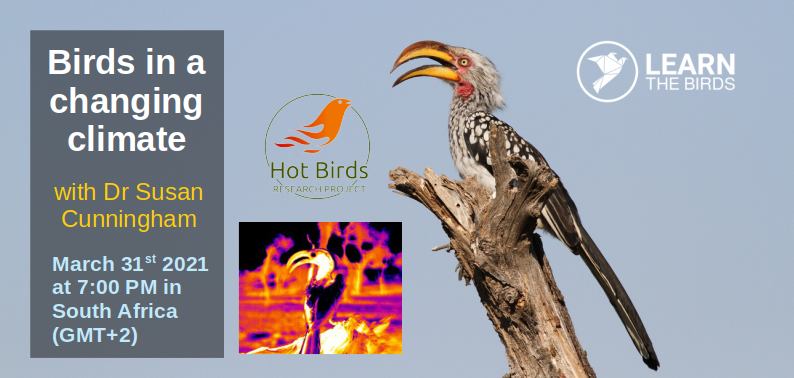
Susie is a senior lecturer at the FitzPatrick Institute, University of Cape Town. She has been involved in the Hot Birds Research Project, an international collaboration investigating the impact of climate change on desert birds globally, since 2010. She leads the team's research on birds' behavioural responses to heat and consequences of these. Susie is a New Zealander and completed her undergraduate degrees in Ecology & Biodiversity and Classical Studies at Victoria University of Wellington in 2005, and her PhD on tactile sensory systems in birds at Massey University in 2010. She moved to South Africa and spent her first field season in the Kalahari over the summer of 2010/11 - a far cry from her PhD research on kiwi in the cold rainforests of New Zealand! The focus of Susie’s and her students’ field work is on the relationship between thermal biology and behavioural ecology, in particular the fitness consequences of behavioural thermoregulation.
View speaker page

Dr Rita Covas

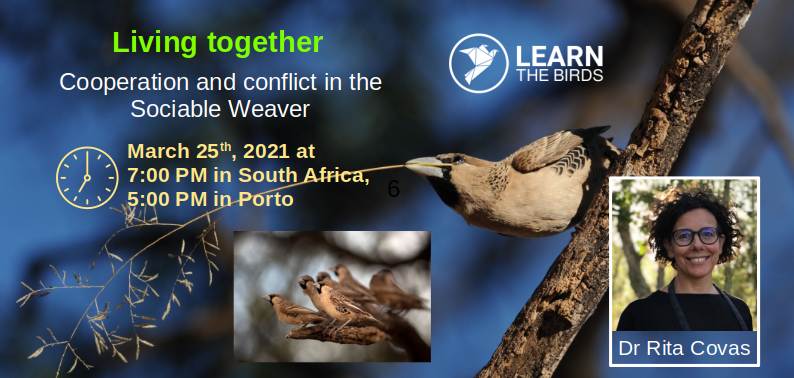
Dr Rita Covas is a behavioural ecologist and evolutionary biologist with a strong interest in the evolution and consequences of sociality and a passion for fieldwork. She uses birds as study models having worked on cooperation using the sociable weaver for nearly 20 years and since 2016 she has been conducting research on another cooperative bird, the southern-ground hornbill. Rita also has a keen interest on island birds, and her research on this topic is mostly done through comparative work and fieldwork in the Gulf of Guinea islands. Rita is a Principal Researcher at CIBIO, University of Porto (Portugal) and Honorary Research Associate at the FitzPatrick Institute, University of Cape Town (South Africa).
View speaker page

Lynette Rudman

Lynette was a foundation phase and preschool teacher for 16 years. She currently writes, designs and creates fabric tactile books for blind preschool readers. Her book, Spider’s Web, won an international tactile book competition in 2009. She is passionate about education and teaching novice birders interesting facts about birds, interesting bird behaviour and bird vocalisations. She is an advocate for ethical birding practices and is not afraid to voice her opinion on this matter. In 2018 she received a merit award from the Grahamstown Rotary Club for her contribution to advancing birding in the Grahamstown area as well as the Eastern Cape Province. Having grown up on a farm and being close to nature all her life, she loves to share her passion for the natural world with others on the two Facebook groups that she created, Eastern Cape Birding and Southern African Bird Calls, and on her Youtube channel. Lynette is a keen photographer of wildlife, including birds, as well as macro photographing of insects and spiders.
View speaker page

Harriet Kemigisha

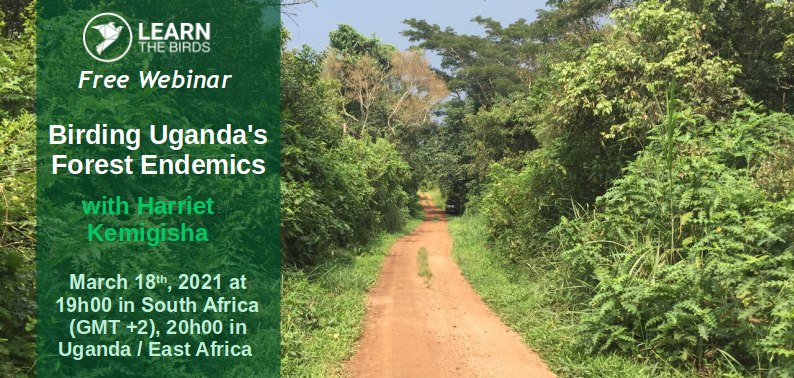
Harriet Kemigisha was born and raised in Western Uganda in Kamwenge District, Bigodi Village near the edge of Kibale national park. She is Uganda’s first female Bird guide, so a real pioneer in her own right. Harriet's passion for wildlife and birds started when she was a little girl growing up with her grandfather at the edge of Kibale National Park. After high school she attended further courses on wildlife management with a special interest in birds,  and then worked for the Uganda Wildlife Authority as a Ranger guide based in Kibale specializing in guiding for Primates and Birds. In 2005, Harriet rediscovered a species of Pitta (Green Breasted Pitta)  that was one of the most hard-to-get species of Pitta in the world, and poorly known to Ornithologists so the news spread around the world about the species. Today hundreds of Birdwatchers come to Uganda every year to observe the Green Breasted Pitta. Harriet has successfully guided many Birding trips on a freelance basis in Uganda and Rwanda and has worked for Avian Vocalization Center (Project Avocet) recording sounds of rare species that have not been recorded by science and are now available on the Project Avocet website. Harriet is now the Director and lead guide at Harrier Tours.
View speaker page

Celiwe Ngcamphalala

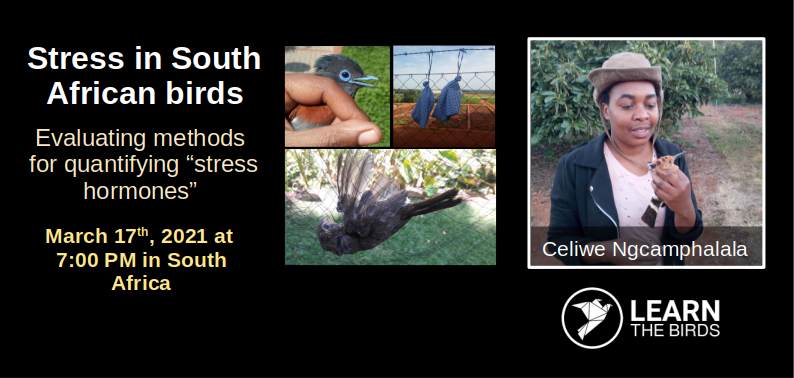
Celiwe Ngcamphalala is a PhD Candidate at the University of Pretoria, and relatively new to the ornithological community! Her interest in birds began in 2013, during her Honours year when Professor Adrian Craig at Rhodes University taught Avian Biology. She became fascinated by bird behaviour and their ‘personalities’. Two years later, she was pursuing a Masters degree, conducting research on the foraging behaviour of white-bellied sunbirds – and she was hooked. For her PhD, she is investigating avian stress responses to activities associated with research, and that is what her talk will be about.
View speaker page

Dr Petra Sumasgutner

Petra is an urban ecologist and raptor researcher who recently transitioned from a post-doc fellowship at the FitzPatrick Institute of African Ornithology, Cape Town to the Konrad Lorenz Research Centre in Austria. She initiated the Viennese Kestrel Project as her PhD research, and graduated from the University of Vienna in 2014. Ever since she has been involved in a variety of post-doc projects, bringing her to Northern Finland and Southern Africa, where she worked on several different urban raptor species, including Black Sparrowhawks, Peregrine Falcons and Crowned Eagles. In her current project she focuses on movement ecology of common ravens and behavioural adaptations in the face of global change and inter-species interactions within the scavenger community of the Alps.
View speaker page

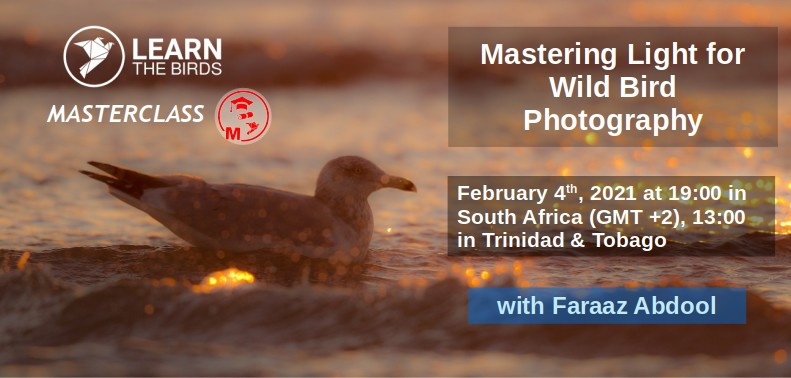
Faraaz Abdool

Faraaz Abdool is an internationally published freelance conservation and wildlife photographer/writer who specializes in birds and the issues they face worldwide. He graciously serves on the Trinidad and Tobago Bird Status and Distribution Committee (formerly the Trinidad and Tobago Rare Bird Committee), and leads birding trips on both islands. Faraaz also runs yearly birding and wildlife tours to East Africa. Faraaz is also the author of “Casual Birding in Trinidad & Tobago”, an extensive volume designed to market T&T as an attractive and easy birding destination as well as to educate the local population about their avian cohabitants. Faraaz cultivates wildlife consciousness via his words and images, in a last-ditch attempt to reconnect humans with nature and save the world.
View speaker page